Inaugural Graphic Medicine Europe Conference X Cross Comix
9-12 September 2026
Vrije Universiteit Amsterdam & De Doelen Rotterdam
We are pleased to announce the inaugural conference of Graphic Medicine Europe, an independent research organization dedicated to the study and practice of Graphic Medicine. For our inaugural conference we are happy to be partnering with Cross Comix, a pioneering Rotterdam-based comics organization that builds bridges between comics, other art disciplines, and social issues locally, nationally, and internationally. Together we are organizing an exciting program of keynote lectures, workshops, artist talks, and other events at the Vrije Universiteit Amsterdam and at the 10th annual Cross Comix festival at De Doelen in Rotterdam, including:
• Ian Williams, keynote lecture
• Ana Patrícia Hilario, keynote lecture
• Eszter Szép, comics brewery
• John Miers and Erin La Cour, Why Graphic Medicine? book launch
• Sabba Khan, artist talk
• Octavia Roodt, artist talk
• Graphic Medicine Exhibition
• Makers Market
• …and much more!
For the more academically focused part of the conference, from 9-10 September at the Vrije Universiteit Amsterdam, we welcome paper and panel proposals that deal with our themes of IMAGINATION, MEDIATION, & MANIFESTATION, whether within, in-between, or across disciplines, practices, and professions.
Read more about our call for papers, panels, workshops, and also about the makers market and zine kiosk at our website. Link in the first comment.
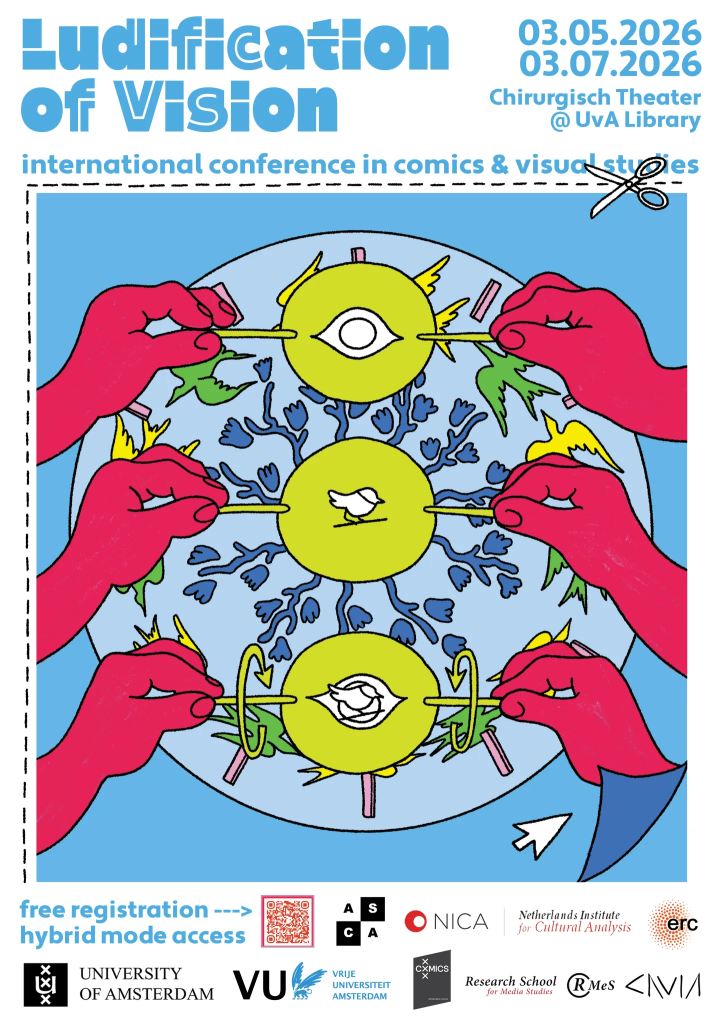
– international conference in comics & visual studies
At the junction of comics and visual studies, this international conference aims to understand how popular media art contributed to the ludification of vision, training our eyes to see in playful, nonlinear and equivocal ways.
ORGANIZING COMMITTEE Mathieu Li-Goyette (UvA), Erin La Cour (VU), Toni Pape (UvA), and Rik Spanjers (UvA)
CREDITS
Poster | Romy Surprenant Volunteers | Teddie Meijer, Ananya Sambasivan, and Annie Wang
PARTNERSHIPS & SPONSORS
Amsterdam Comics Amsterdam School of Cultural Analysis (ASCA) The European Research Council (ERC) Filmhuis Cavia Netherlands Institute for Cultural Analysis (NICA) Research School for Media Studies (RMeS) Vrije Universiteit Amsterdam Universiteit van Amsterdam
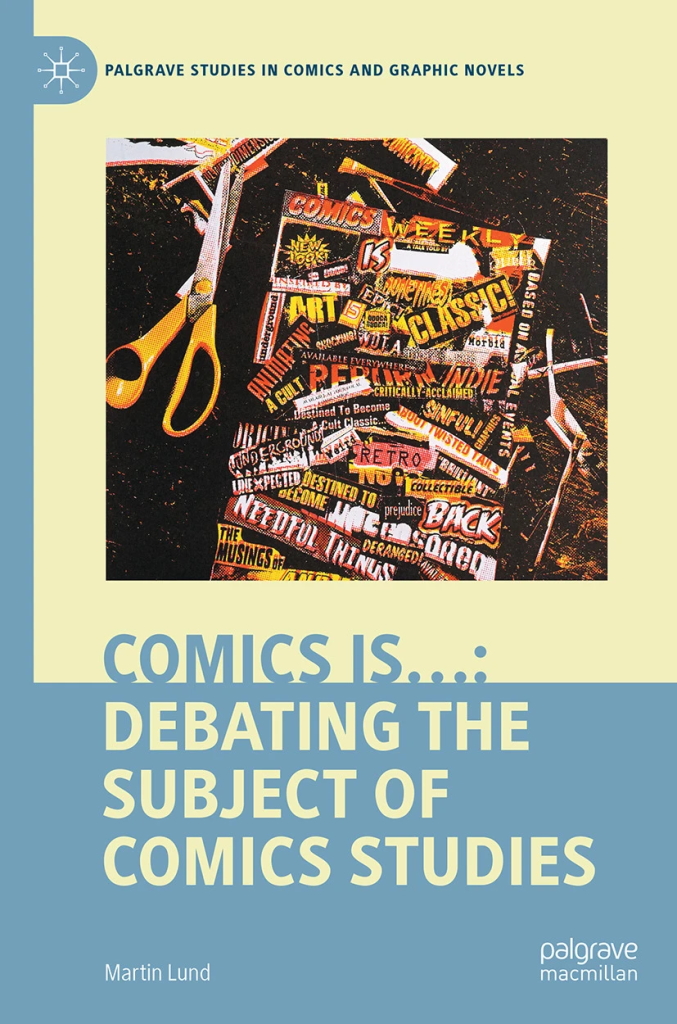
Taking the contested and contestable meaning of “comics” as its starting point, Comics is… brings together ten comics scholars from different disciplines and with different approaches to what some of us call comics, to debate and discuss the foundations of Comics Studies in a provocative and thought-provoking way.
The book is built around a three-part structure: each contributor writes a sentence or brief statement, starting from the prompt “Comics is…”; a colleague replies to the statement with a reflection, critique, or application of the statement or the position it advances; and, finally, the author of the statement responds to the reply in a brief essay.
Through its dialogical format, the book is likely to spark new conversations in the field; the statement–response–reply format will illustrate that the ways we think as comics scholars are processual, and any reader will find things they agree and disagree with in its pages – and, more importantly, will find occasion to reevaluate their own thinking.
Furthermore, when taken together, the “Comics is…” statements along with the responses and replies provide a barometer of the state of Comics Studies at present, exemplifying current approaches within the field and some of the thinking behind why some of us do our work in certain ways, while others choose sometimes radically different ones.
With: Marc Singer, Bart Beaty, Harriet Earle, Joanna Davis-McElligatt, Johnathan Flowers, Eszter Szép, Barbara Postema, Fredrik Strömberg, Frederick Luis Aldama, Benjamin Woo.
The 4th International Comics Conference at Malmö University (12) 13–14 November 2026 Deadline: 15 April 2026, Notification of acceptance: no later than 30 April 2026.
How is narrative constructed and negotiated through the material forms and practices of comics? Building on Malmö University’s strong focus on storytelling and comics research this conference invites scholars, practitioners, and reflective creators to explore what it means to craft narratives that participate in the construction of social, political, or emotional realities. How do storytelling strategies in comics (sequencing, stylisation, visual rhythm) interact with material choices, identity, and imagination?
Possible questions include (but are not limited to):How can the tactile and physical engagement with comics as objects foster a unique sensory, emotional, and intimate connection between reader and creator?
•How do reader interpretations, participatory practices, fan engagements or living narrativesshape the storytelling in comics?
•What responsibilities do comics creators hold when representing contested histories, identities,or traumas?
•How do the material forms of comics differ across cultural contexts, and what can thesedifferences teach us about diverse storytelling traditions?
•What ritualistic or performative elements emerge in the making, reading, or sharing of comics?
•How can we preserve the material legacies of comics for future inquiry, ensuring that thephysical dimensions of the medium remain accessible for analysis and inspiration?
•In what ways do the stories we, as researchers, tell about the pioneers or ”the most influential”creators shape the discourse of comics studies? How do these academic narratives influence thefuture of the comics medium itself?
In line with the current public discourse, we also encourage reflections on canon formation, not only in academic discourse but also in publishing, teaching, curation, and practice. What comics do we preserve, study, translate, or showcase, and what falls through the cracks?
Submissions may take the form of academic papers, practice-based presentations, or hybrid formats. The first day (12 November) will serve as a pre-conference day in collaboration with the Comics Archive in Malmö, offering participants the opportunity to visit the archive and/or engage in focused research on specific materials. Pre-registration is required for this day.
Abstracts (max 300 words) and a short bio (max 100 words) should be submitted by 15 April 2026. Notification of acceptance will be sent out by 30 April 2026.The conference will be held on-site at Malmö University, Sweden. Further details including keynote speakers, registration, and programme will be announced during the summer of 2026.Contact: oskar.aspman@mau.se
An advancement in comics education at Malmö university
Malmö University will add a new comics course on advanced level, beginning in January 2026. We have asked Course responsible, Associate Professor/Senior Lecturer Jakob Dittmar, to answer some questions regarding this new and unique course.
Question: Malmö University currently offers four free-standing comic-courses*, so how does this new one, The Graphic Novel as Visual Literature, differ from the others?
Answer: The course on The Graphic Novel is the first comics-course at Malmö University that is dedicated to analysis and theory and does not include a larger production of a comic. We will do exercises with comics production to understand different aspects in comics narration better, the main work is reading and interpreting selected graphic novels as literature. The course only looks at fictional stories, graphic novels in the true sense of the word!
The course Documentary Comics will run in parallel to this course and is restricted to factual narrations, and there, a major production is central to the learning outcomes. Graphic novels often take many years until they are published, this cannot be done on a university course, but it can be supported by the course.
Question : How does this new course help to advance the field of comics-studies?
Answer: The Graphic Novel course applies and advances the toolbox we have for analysing comics – it combines theories and methods from literary studies and comics studies, we will work with issues established in visual communication, graphic design, and media studies as well as literary studies to really look into the details of graphic novels.
The focus is on understanding better how individual comics use pictorial and textual elements to tell their story in just their individual voice and style.
Question: Who would you recommend applying to this course?
Answer: People, who want to understand better what it is that makes a graphic novel work really – how graphic style, composition of images and pages, and the texts, all work together to create visual literature that is as substantial as text-only novels.
People who want to do their own graphic novels in the future will benefit from this course as much as people who want to do literary studies on visual literature!
The course is aimed at students that know how academic courses work, how analysis and theory work, it is on advanced level.
The course is for students who can benefit from and contribute to an online course. Experience with reading longer comics is expected, experience with comics production are not needed but are no disadvantage.
– A research seminar focusing on comic-art and graphic noveling.
The starting point for the Everyday Comic-Art Network and a release for the presentation of the comic-art based project: Det är i vardagen det händer – Tecknade serier för att skapa tryggare grannskap (It happens in the everyday – Comic-art to create safer neighborhoods).
9 Dec 2025. 09:00 – 16:00 Location: Glashuset, HDK-Valand. Entrence Storgatan 43 or Vasagatan 50, Göteborg Additional info. Zoom link is provided.
Organizers: Mathieu Li-Goyette, Erin La Cour, Toni Pape, Rik Spanjers
At the turn of the 20th century, techniques of observation and of visual representation were achieving an exponentially fast industrial revolution of production, distribution, and reception. Presses and cameras were faster, more precise, and as their influence on society rapidly broadened, a whole new set of visual practices became available to artists. Since then, vision has become fully fragmented or accelerated, with the collapse of “classical models of vision and their stable space of representations. Instead, observation [became] increasingly a question of equivalent sensations and stimuli that have no reference to a spatial location” (Crary 1990). These advancements encouraged a perpetual deconstruction of vision prompting new techniques of representation, which are still ongoing in our technological age.
During this period, print and visual media developed new modes of combining words and images that both dynamize vision and normalize it in new directions. This results in media forms that playfully engage the eye in nonlinear visual explorations, forms that are implicitly forces of deinstitutionalization of subjects, framing, and usages. Examples can be found in comic strips and magazines, but also advertisements, games, miniatures, puzzles, rebus, travelogues and visual bibles.
This conference invites an intermedial reflection on the development of modes of reading and seeing in relation to constraints of production and distribution. We welcome contributions on subjects ranging from a medium’s early stages of development up to the present digital world, while addressing issues of readability, narrativity, interactivity, and/or materiality. How did new ludic modes of seeing develop from scientific observation to artistic production? What techniques did artists develop to increase the readability of their medium? How did they negotiate the tensions between originality and standardization? What new visual norms were established along the way?
Bringing together scholars and practitioners, the conference aims to understand how popular media art contributed to the ludification of vision, training our eyes to see in playful, nonlinear and equivocal ways.
We welcome submissions on any aspect of ludification in the visual arts and its adjacent practices. Please send an abstract (300 words maximum) with a title, bio, and a brief bibliography related to the paper (maximum of 5 titles) through this submission formby October 31st. We plan to announce decisions by November 21.
Bibliography
Beringer, Alex. 2024. Lost Literacies. Columbus: Ohio State University Press.
Crary, Jonathan. 1992. Techniques of the Observer: On Vision and Modernity in the Nineteenth Century. Cambridge: MIT Press.
De Koven, Bernard. 2025. The Well-Played Game: A Player’s Philosophy. Cambridge: MIT Press.
Ensslin, Astrid and Alice Bell. 2021. Digital Fiction and the Unnatural: Transmedial Narrative Theory, Method, and Analysis. Columbus: Ohio State University Press.
Gardner, Jared. 2012. Projections: Comics and the History of Twenty-First-Century Storytelling. Stanford: Stanford University Press.
Gaudreault, André. 2009. From Plato to Lumière. Toronto: University of Toronto Press.
Gidding, Seth. 2024. Toy Theory. Cambridge: MIT Press.
Hatfield, Charles. 2005. Alternative Comics: An Emerging Literature. Jackson: University Press of Mississippi.
Horstkotte, Silke and Nancy Pedri. 2022. Experiencing Visual Storyworlds: Focalization in Comics. Columbus: Ohio State University Press.
Kashtan, Aaron. 2019. Between Pen and Pixel: Comics, Materiality, and the Book of the Future. Columbus: Ohio State University Press.
LaMarre, Thomas. 2009. The Anime Machine. Minneapolis: University of Minnesota Press.
Macfarlane, Robert. 2007. Original Copy: Plagiarism and Originality in Nineteenth- Century Literature. Oxford: Oxford University Press.
Morgan, David. 1999. Protestants and Pictures: Religion, Visual Culture, and the Age of American Mass Production. Oxford: Oxford University Press.
Saguisag, Lara. 2019. Incorrigibles and Innocents: Constructing Childhood and Citizenship in Progressive Era Comics. New Brunswick: Rutgers University Press.
Stewart, Susan. 1993. On Longing: Narratives of the Miniature, the Gigantic, the Souvenir, the Collection. Durham: Duke University Press.
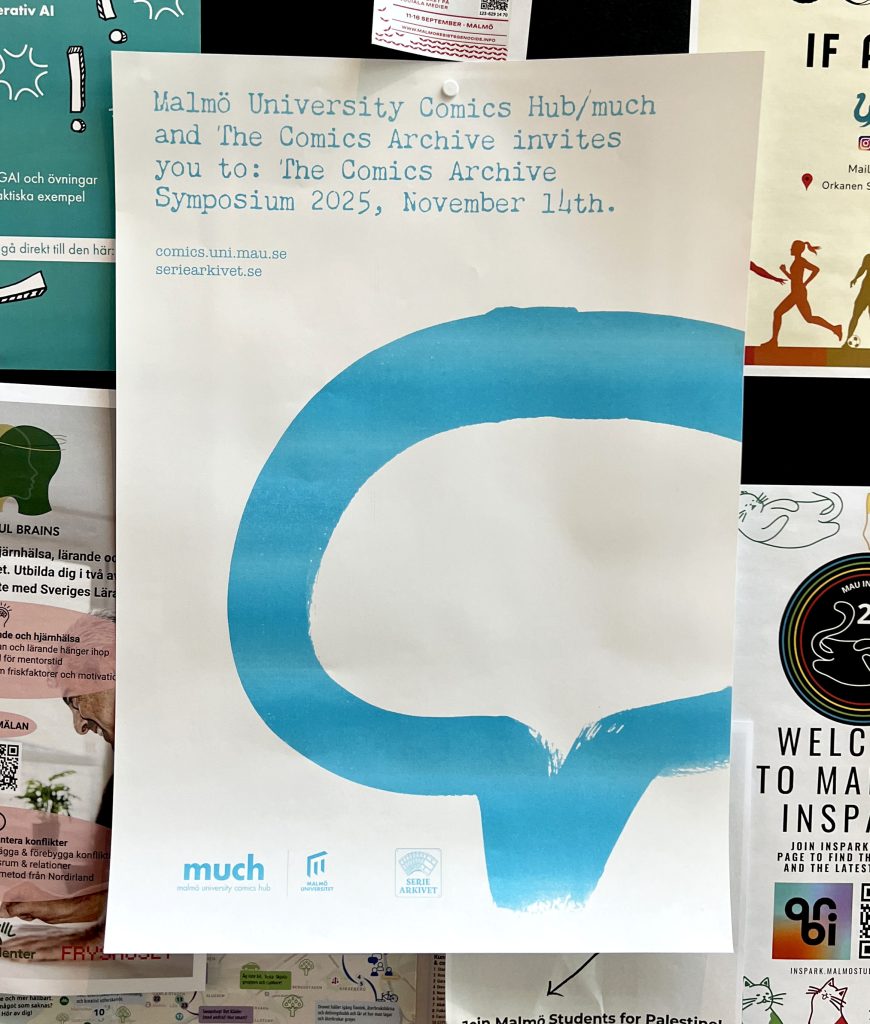
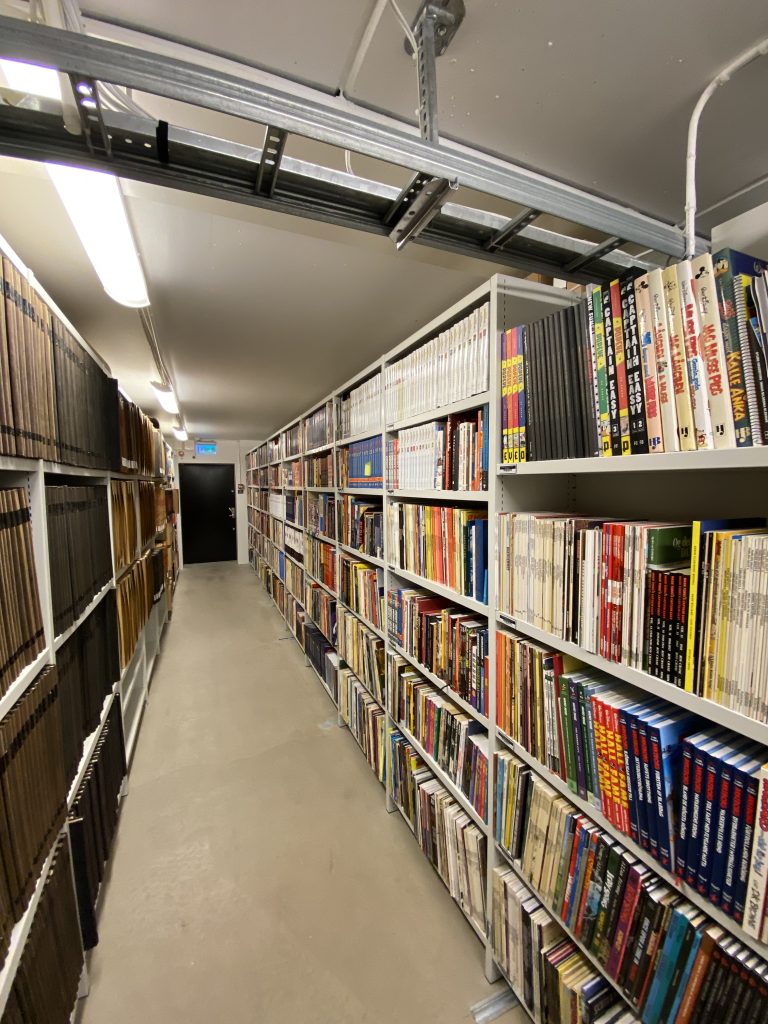
The Comics Archive in Malmö has expanded significantly in recent years through large donations. To provide a better overview and inspire scholars to initiate new projects, Malmö University Comics Hub/much and The Comics Archive invites you to a full-day symposium where we will present some of the most important additions. During this full-day symposium, comic scholars will also provide different perspectives on comics research and parts of the collections will be presented thematically. The goal is to inspire you to initiate new research with the starting point in the archive’s unique and largely unresearched collections.
The Symposium will be in the form of presentations and workshop, so there will be no call for papers.
Target group: Comics-scholars and PhD-students.
Cost: Free.
Date: November 14, 2025.
Place: Malmö university, K3-Studio, Nordenskiöldsgatan 1 and The Comics Archive, Friisgaan 19b, Malmö.
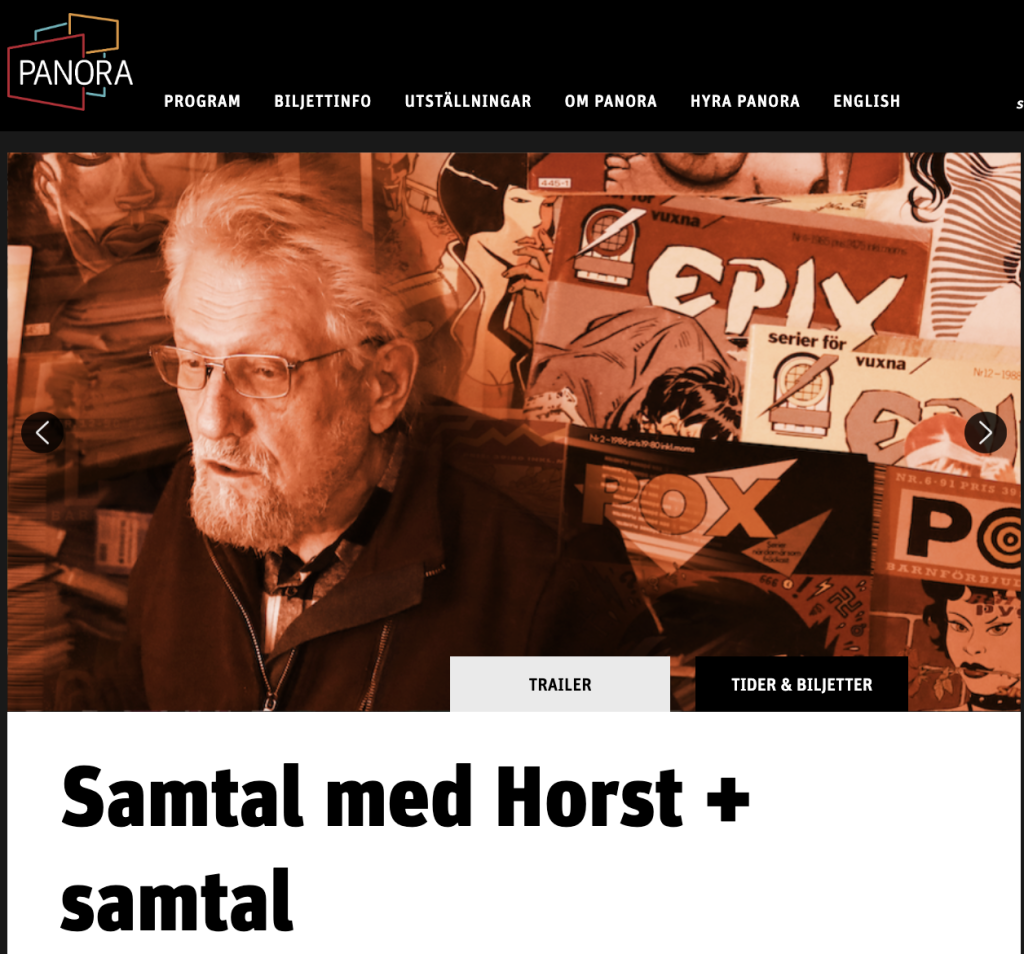
Filmvisning på Panora om serierevolutionen på 80-talet.
Onsdag 7/5 kl 18.30
”Jag har ju egentligen inte växt upp med serier.” Så inleds filmen om och med Horst Schröder – serietidningsförläggaren som förändrade Seriesverige för alltid. Välkommen på visning av Samtal med Horst följt av ett samtal mellan Fredrik Strömberg och Gunnar Krantz.
I Samtal med Horst möter vi Horst Schröder, förlagschef på Epix Förlag, i en nära och personlig berättelse om hans liv. Från en tuff uppväxt i efterkrigstidens Tyskland till ett akademiskt liv – och kärleken som förde honom till Sverige. Nästan av en slump kom han sedan att skapa ett av de mest tongivande och kontroversiella förlagen i svensk seriehistoria.
Efter visningen samtalar journalisten, författaren och forskaren Fredrik Strömberg med Gunnar Krantz, serieskapare och konstnärliga professor på Malmö universitet och tillika medarbetare till Horst Schröder på förlaget Epix under 1980-talet. Samtalet kommer att fokusera på Krantz tid på förlaget, alla de kontroverser som uppstod och skälen till varför han till slut lämnade Epix.
Doctoral student in Media and Communication Studies at the Faculty of Culture and Society, the School of Arts and Communication, focusing on storytelling.
Work duties
Those appointed to doctoral studentships shall primarily devote themselves to their studies. Those appointed to doctoral studentships may work to a limited extent with educational tasks, research, artistic research, and administration. However, duties of this kind may not comprise more than 20 per cent of a full-time post (Higher Education Ordinance (HEO) Chapter 5, section 2).
The doctoral education concludes with a doctoral degree and comprises 240 credits, which corresponds to four years of full-time study. The programme consists of courses and an independent research project that is presented in a doctoral thesis. As a doctoral student, you will be expected to play an active part in the research and educational environment and, when applicable, in the research programmes of the Department/School.
The doctoral education is carried out within the academic environment storytelling at the School of Arts and Communication (K3). This environment explores narratives in various forms, with a special focus on what is traditionally described as aesthetic forms of expression and on journalistic/documentary storytelling. The media and art forms that are mainly in focus are literature, film, art, graphic novels and comics, photography, and journalism. Ongoing research projects deal with, among other things, literary representations of class, work, and the relationship between the urban and the rural, creative writing, comics, literary material in the trade-union press and documentary storytelling in various media. The doctoral student’s dissertation project shall contribute to the development of the research environment of storytelling.